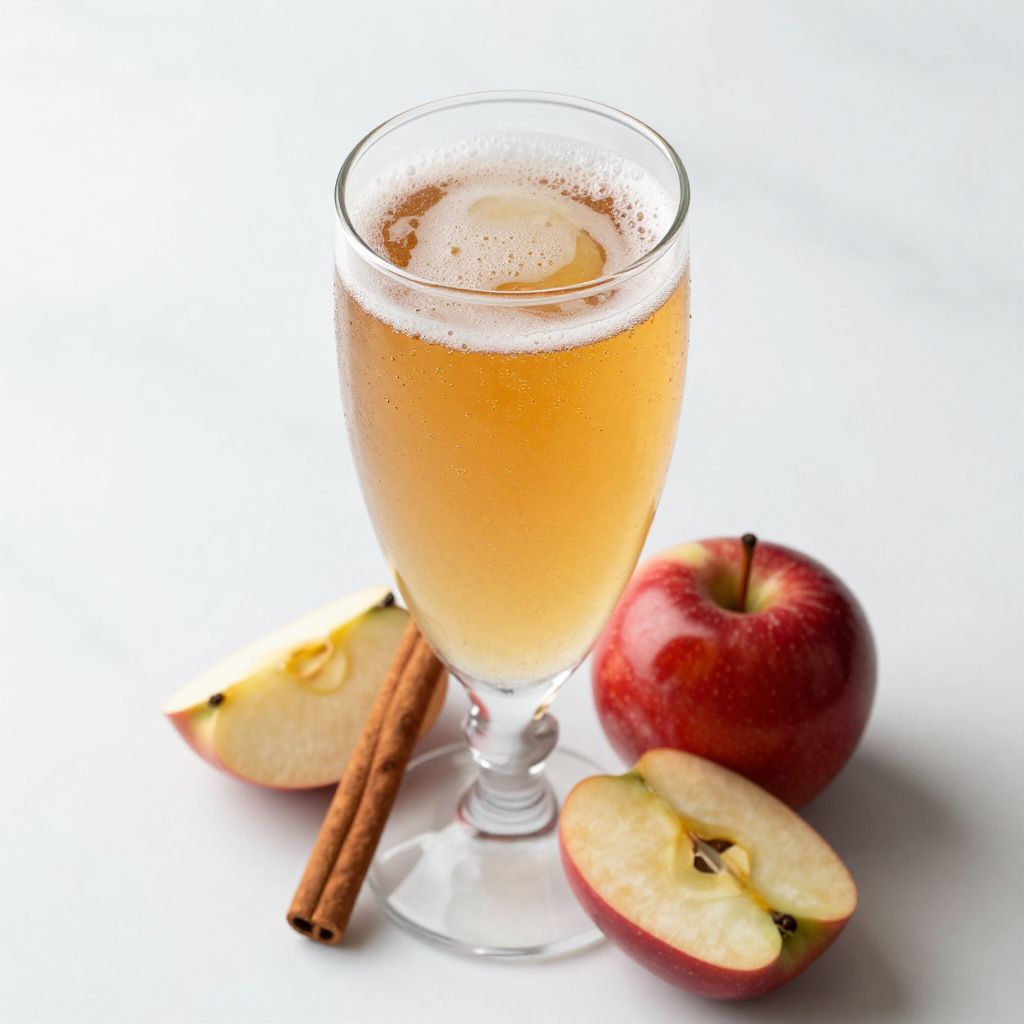
Ingredients
Equipment
Method
- Mix sanitizer according to package directions (typically 1 teaspoon per gallon of water for Star San) and soak your carboy, airlock, tubing, and any other equipment that will touch the cider for at least 5 minutes.
- Pour your 5 gallons of apple juice into a large, clean bucket or directly into your carboy. If using refrigerated juice, allow it to come to room temperature (around 65 to 70 degrees Fahrenheit).
- Stir 1 teaspoon of yeast nutrient directly into the apple juice and mix well for about 30 seconds to distribute evenly.
- Pour a small amount of warm (not hot) apple juice into a sanitized glass and sprinkle your yeast packet over it, letting it sit for 5 to 10 minutes to rehydrate.
- Stir the rehydrated yeast gently and pour the entire mixture into your carboy of apple juice. Swirl the carboy gently a few times to distribute the yeast evenly.
- Fill your airlock with sanitizer or a weak water solution (half water, half sanitizer) and attach it to the carboy's stopper. Within 24 to 48 hours, you should see steady bubbling indicating fermentation has begun.
- Keep your carboy at a stable temperature between 65 and 75 degrees Fahrenheit, away from direct sunlight, for 2 to 3 weeks during primary fermentation. You'll notice vigorous bubbling during this phase.
- After 2 to 3 weeks when bubbling slows noticeably, use a sanitized siphon to transfer your cider from the primary carboy to a clean secondary carboy, leaving behind the sediment at the bottom.
- Attach a fresh airlock filled with sanitizer, and let the cider sit for another 2 to 4 weeks at stable temperature for secondary fermentation and clarification.
- Once fermentation has truly stopped (no airlock activity for several days and stable hydrometer readings), rack the cider one final time into bottles. For carbonation, add 1/4 to 1/2 teaspoon of priming sugar per 12-ounce bottle. For flat cider, simply fill bottles without priming sugar.
- Store bottles upright in a cool, dark place for 1 to 2 weeks if carbonating, or immediately refrigerate if you prefer it flat.
Notes
Temperature control is your secret weapon; consistent 65 to 70 degree Fahrenheit fermentation produces cleaner flavor and faster completion. Always use juice without potassium sorbate preservative, as this will prevent fermentation. Fermentation time is 4 to 6 weeks total, plus 1 to 2 weeks conditioning time.