
The rich aroma of honey and malt mingling together is pure magic, and that’s exactly what drew me to braggot the first time I encountered it. This ancient beverage bridges the gap between beer and mead, combining the smooth sweetness of honey with the complex depth of malted grains to create something truly special.
Braggot holds serious appeal for home brewers and curious drinkers alike because it offers a unique flavor profile that neither pure beer nor pure mead can achieve on their own. The honey adds a silky mouthfeel and subtle floral notes, while the malt provides structure, body, and familiar beer-like characteristics that make it approachable and genuinely delicious.
Why You’ll Love This Recipe
Braggot rewards patience with a drink that tastes far more complex than the sum of its parts. Here’s what makes it a worthy project:
- Smooth, balanced flavor combining honey sweetness with malty depth
- Forgiving fermentation process suitable for beginning brewers
- Customizable alcohol content and flavor intensity based on your preferences
- Impressive result that impresses friends and family at gatherings
- Relatively short aging timeline compared to traditional meads
My Experience Making This Recipe
I brewed my first batch on a crisp autumn afternoon, and the transformation from cloudy wort to clear, amber liquid was honestly mesmerizing. The first aroma that hit me when I cracked open a bottle three months later was honeyed toast with a hint of spice, and I knew immediately that all the waiting had been worth it.
My brewing group gathered for a tasting night, and everyone reached for seconds without hesitation. One friend who typically drinks hoppy IPAs found herself completely smitten with the smoothness, while my honey-loving aunt declared it the perfect bridge between her beloved mead and her husband’s preference for beer.
The real magic happened at a winter dinner party when I paired braggot with a honey-glazed duck dish. The honey notes in the drink echoed the glaze beautifully, creating a harmony that made both the food and the beverage taste even better.
Recipe Overview
- Recipe Name: Braggot (Honey Ale)
- Servings: Makes approximately 5 gallons (19 liters), or about 50 twelve-ounce servings
- Prep Time: 30 minutes
- Brew Day Duration: 4 to 5 hours
- Total Fermentation Time: 8 to 12 weeks
- Course: Beverage
- Cuisine: Medieval/European
- Alcohol Content: Approximately 7.5 to 9 percent ABV
- Calories per Serving: Approximately 120 to 140 calories
Equipment You Will Need
- Large brewing kettle (10+ gallon capacity)
- Thermometer (accurate to 1 degree Fahrenheit)
- Hydrometer (for measuring gravity)
- Primary fermentation vessel (6+ gallon carboy or bucket with airlock)
- Secondary fermentation vessel (optional carboy)
- Airlock and rubber bung
- Large stainless steel spoon for stirring
- Cheesecloth or mesh strainer
- Auto-siphon with tubing
- Bottling bucket with spigot
- Bottle caps and capper
- Beer bottles (approximately 50 twelve-ounce bottles)
- Sanitizer (Star San or similar)
- Scale for measuring ingredients
Ingredients for Braggot
- Pale malt extract or 2.5 pounds crushed pale two-row malt (for all-grain version)
- Raw honey (3 to 5 pounds, depending on desired sweetness)
- Bittering hops (0.5 ounce of Willamette or Fuggle hops)
- Aromatic hops (0.5 ounce of Hallertau or Saaz hops for finishing)
- Ale yeast (one packet of SafAle US-05 or Wyeast 1056 American Ale)
- Yeast nutrient (0.5 teaspoon)
- Water (approximately 5.5 gallons of filtered or dechlorinated water)
- Priming sugar (0.75 cup corn sugar or dextrose for carbonation)
- Salt (pinch, optional)
Ingredient Notes and Substitutions
- Pale Malt Extract: This forms the backbone of your braggot, providing fermentable sugars and malty flavor. Substitute with all-grain brewing (2.5 pounds pale two-row malt steeped at 150 to 155 degrees Fahrenheit for 30 minutes) for more control and slightly richer flavor, though the process becomes more involved.
- Raw Honey: Raw honey brings complexity and subtle floral notes that pasteurized honey cannot match. Pasteurized honey works but tastes slightly more one-dimensional; use the same amount but expect less interesting secondary flavors.
- Bittering Hops: Willamette provides a traditional, herbal bitterness that pairs beautifully with honey. Fuggle offers similar characteristics with slightly more earthy undertones, or use Tettnang for a more delicate approach.
- Aromatic Hops: Hallertau brings a noble, floral quality that complements the honey perfectly. Saaz offers a spicier note; substitute with Tettnang if you prefer something softer and more subtle.
- Ale Yeast: SafAle US-05 is reliable and forgiving, producing clean fermentation with minimal off-flavors. Wyeast 1056 creates slightly more ester complexity if you prefer a fruitier character.
- Yeast Nutrient: This supports yeast health during fermentation, preventing stuck fermentations common in honey-based brews. Skip it if unavailable, but accept slightly higher risk of sluggish fermentation.
How to Make Braggot
Step 1: Sanitize Your Equipment
Before you brew anything, sanitize every piece of equipment that will contact your wort or finished braggot with a no-rinse sanitizer like Star San. This is non-negotiable because any infection will ruin months of work and turn your beautiful braggot into something undrinkable.
Step 2: Heat Your Water
Pour 5.5 gallons of filtered or dechlorinated water into your brewing kettle and heat it to 160 degrees Fahrenheit. You’re aiming for this precise temperature because if the water is too hot, you’ll extract harsh, astringent flavors from the malt, and too cool means weak extraction.
Step 3: Steep the Malt Extract or Grains
If using all-grain, add your 2.5 pounds of crushed pale two-row malt to the water at 160 degrees and maintain that temperature for 30 minutes, stirring occasionally. If using malt extract, skip this step and add the extract in step 5 instead; extract-based braggots ferment faster and require no steeping.
Step 4: Bring Wort to a Boil and Add Bittering Hops
Slowly increase the heat until your wort reaches a rolling boil, which takes 15 to 20 minutes. Once boiling, immediately add 0.5 ounce of bittering hops (Willamette or Fuggle) and note the time; these will boil for the full 60 minutes to extract maximum bitterness that balances the honey’s sweetness.
Step 5: Add Honey at Midpoint
After the wort has boiled for 30 minutes, slowly pour in 3 to 5 pounds of honey depending on how sweet you want your final braggot. Add it slowly because cold honey hitting hot wort can cause vigorous boiling and overflow; stir well to fully dissolve the honey into the wort.
Step 6: Add Aromatic Hops at End of Boil
With 5 minutes remaining in your 60-minute boil, add 0.5 ounce of aromatic hops (Hallertau or Saaz) and your 0.5 teaspoon of yeast nutrient. These late-addition hops preserve their delicate floral character, and the nutrient helps your yeast thrive during fermentation.
Step 7: Cool the Wort Rapidly
Once your 60-minute boil finishes, remove the kettle from heat and let it sit for 5 minutes. Pour the wort through cheesecloth or a mesh strainer into your sanitized primary fermentation vessel, which sits in an ice bath; rapid cooling to below 75 degrees Fahrenheit prevents contamination and reduces harsh flavors.
Step 8: Check Gravity and Pitch Yeast
Once cooled to room temperature (65 to 70 degrees Fahrenheit), use your hydrometer to measure the original gravity, which should read between 1.055 and 1.080 depending on honey amount. Pitch your yeast packet directly into the cooled wort, cover with an airlock, and place in a cool, dark location.
Step 9: Monitor Fermentation
You should see active bubbling through the airlock within 12 to 24 hours; if not, gently shake the carboy to rouse the yeast. Fermentation continues for 4 to 8 weeks depending on yeast strain and temperature; warmer fermentations proceed faster but may produce more esters and less clean flavors.
Step 10: Transfer to Secondary (Optional)
After primary fermentation slows (bubbling slows to one bubble every 5 to 10 seconds), carefully siphon your braggot into a sanitized secondary fermentation vessel using an auto-siphon. Secondary fermentation for 2 to 4 weeks allows sediment to settle and flavors to mature, though this step is optional for faster results.
Step 11: Bottle Your Braggot
Once fermentation is complete (final gravity reading stays the same for three days in a row), mix 0.75 cup of priming sugar with 0.5 cup of water, heat to dissolve, cool, and stir into your braggot in a sanitized bottling bucket. Siphon into sanitized beer bottles and cap immediately; the priming sugar creates carbonation over 2 to 3 weeks.
Step 12: Condition at Room Temperature
Let bottles sit upright at room temperature for 2 to 3 weeks before chilling and opening. After this conditioning period, your braggot develops proper carbonation and allows flavors to marry and smooth out into that perfect honey-malt balance.
Pro Tip: If your fermentation seems stuck after two weeks with no gravity change, add a small starter of fresh yeast (0.25 teaspoon dry yeast mixed with 0.5 cup of apple juice left overnight) to restart it, because stuck fermentations waste your honey and ingredients.
Tips for the Best Braggot
- Use raw, unfiltered honey if you can find it, as it brings more complexity and subtle floral notes than pasteurized honey. The live enzymes and pollen in raw honey add character that’s difficult to replicate.
- Keep fermentation temperature between 65 and 70 degrees Fahrenheit for the cleanest flavor; warmer temperatures produce fruity esters that muddy the honey-malt balance you’re pursuing.
- Avoid adding too much honey upfront because braggot relies on balance between grain sweetness and honey sweetness. Start with 3 pounds and increase in future batches if you prefer more honey character.
- Use a secondary fermentation vessel to reduce contact with sediment, which can impart off-flavors and muddy clarity. Even two extra weeks in secondary dramatically improves smoothness and brightness.
- Bottle in glass rather than attempting kegging for your first batch, as bottling is more forgiving and easier to manage for small batches.
- Resist the urge to open bottles early; the 2 to 3 week conditioning period is when the magic really happens as flavors marry and carbonation develops.
Common Mistakes to Avoid
- Adding honey too quickly at boil causes vigorous boiling and ingredient loss; pour slowly and stir continuously to integrate without overflow.
- Fermenting too warm (above 72 degrees Fahrenheit) produces fruity off-flavors and esters that overpower the delicate honey character you’re working to achieve.
- Skipping the yeast nutrient in honey-based brews frequently results in stuck fermentations where yeast simply gives up halfway through.
- Bottling before fermentation is truly complete causes bottle bombs from over-carbonation; always confirm final gravity readings stay identical for three consecutive days.
- Using heavily processed, pasteurized honey removes the subtle complexity that makes braggot interesting compared to regular beer.
Serving Suggestions
Braggot shines when served properly chilled in a tulip glass or standard pint glass, allowing you to appreciate both the visual clarity and the aromatic complexity. The smooth, honey-forward character pairs beautifully with a wide range of foods and occasions.
- Cheese and charcuterie boards featuring aged cheddar, brie, and prosciutto, where the honey notes echo the bread’s toast character
- Roasted chicken with herb butter, as the malt provides body that complements poultry without overwhelming delicate flavors
- Honey-glazed ham or pork ribs, creating a flavor echo that makes both food and drink taste even better
- Apple tart or honey cake desserts, where braggot acts as the perfect palate-cleansing complement
- Light appetizers and nuts at casual gatherings, since the smooth character makes it approachable for non-beer drinkers
Variations to Try
- Spiced Braggot: Add 0.5 teaspoon of ground ginger and a pinch of nutmeg during the final 5 minutes of boiling for warm spice notes that amplify the honey’s complexity. This variation creates a drink that feels warming and sophisticated.
- Fruit Braggot: Add 1 pound of dried apricots or figs during secondary fermentation to introduce complementary stone fruit or fig notes that layer beautifully under the honey. The fruit adds subtle sweetness and interesting depth without overpowering the base character.
- Higher Alcohol Braggot: Increase honey to 5 or 6 pounds and extend fermentation to 12 or 16 weeks for a stronger, dessert-like version that approaches mead territory. The higher alcohol content allows longer aging and mellowing for truly complex results.
- Dry Braggot: Reduce honey to 2.5 pounds and use yeast nutrient generously to ensure complete fermentation of all sugars for a crisper, more beer-like drinking experience. This version appeals to those who prefer dryness over residual sweetness.
- Herbal Braggot: Replace some bittering hops with 0.5 teaspoon of dried chamomile or 0.25 teaspoon of dried rosemary added during secondary fermentation for floral or herbal complexity. This creates a more meditation-friendly beverage with calming undertones.
Dietary Adaptations
- Gluten-Free: Substitute malt extract with gluten-free malt extract or use certified gluten-free grains like sorghum malt in place of barley; the fermentation process remains identical but gluten-free versions may produce slightly less body and require 10 to 15 percent more honey for balance.
- Vegan: Standard braggot is already vegan since it contains only honey, grains, hops, and yeast; confirm your specific honey source aligns with vegan values since some brewers prefer plant-based sweeteners like agave nectar as a substitute.
- Lower Alcohol: Reduce honey to 2 pounds and use nutrient-light yeast like SafAle S-04 English Ale to slow fermentation and reduce final alcohol to 4 to 5 percent ABV; this creates a sessionable version for longer drinking occasions.
- Low-Sugar Option: Skip priming sugar during bottling and force-carbonate with a CO2 keg system instead, though home brewers without kegging equipment should accept flat braggot to avoid residual fermentation sugars.
Storage and Reheating
Refrigerator
Store unopened bottles in the refrigerator at 35 to 40 degrees Fahrenheit for up to one year, keeping them away from light. Properly sealed bottles maintain carbonation and flavor quality throughout this period without degradation.
- Keep bottles upright to minimize cork contact and oxidation
- Maintain consistent cool temperature away from temperature fluctuations
- Store in darkness since light degrades hop compounds and honey notes
Freezer
Braggot does not freeze well since the alcohol content prevents solid freezing while alcohol volatilization alters the balance. Freezer storage is not recommended for this beverage.
Reheating
Braggot should never be heated or warmed; serve chilled or at cellar temperature depending on your preference. Warming destroys carbonation, volatilizes aromatic compounds, and ruins the drinking experience.
- Serve braggot at 45 to 55 degrees Fahrenheit for optimal flavor expression
- Allow bottles to warm from refrigerator for 5 to 10 minutes before serving for better aroma perception
- Never microwave or heat braggot under any circumstances
Nutrition Information
| Nutrient | Amount |
|---|---|
| Calories | 120 to 140 per 12 oz serving |
| Total Fat | 0 grams |
| Saturated Fat | 0 grams |
| Carbohydrates | 8 to 12 grams |
| Fiber | 0 grams |
| Sugar | 3 to 8 grams |
| Protein | 0.5 to 1 gram |
| Sodium | 5 to 10 milligrams |
| Cholesterol | 0 milligrams |
Nutritional values vary based on exact honey amount used and residual sugar remaining after fermentation. Higher honey additions increase carbohydrate and sugar content, while complete fermentation reduces final sugar levels significantly.
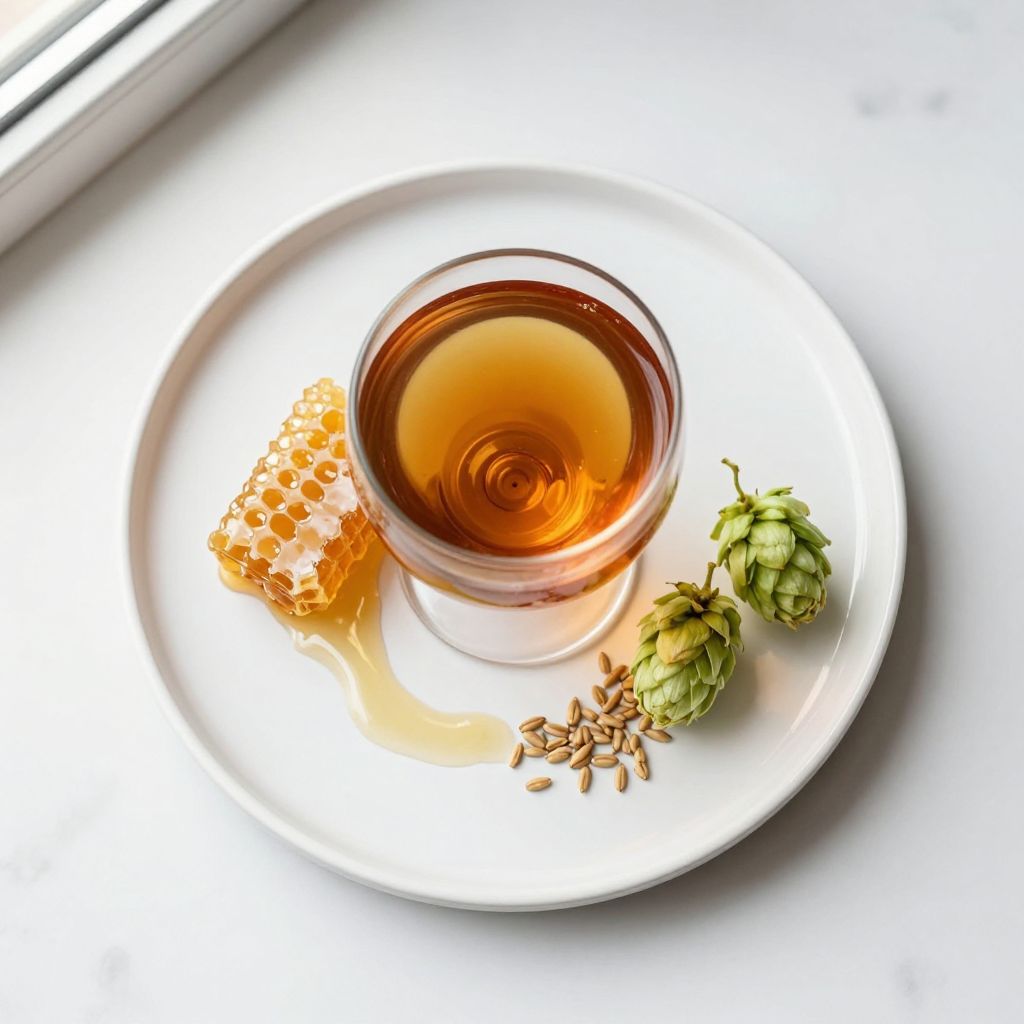
Braggot (Honey Ale)
Ingredients
Equipment
Method
- Sanitize all brewing equipment with a no-rinse sanitizer like Star San, ensuring wort and braggot contact surfaces are clean.
- Heat 5.5 gallons of filtered or dechlorinated water in a large brewing kettle to 160 °F (71 °C).
- If using crushed grains, steep 2.5 pounds of pale two-row malt in the water at 160 °F (71 °C) for 30 minutes, stirring occasionally; if using extract, skip this step.
- Bring the wort to a rolling boil (approx. 15–20 minutes) and add 0.5 ounce of bittering hops; boil for a total of 60 minutes.
- After 30 minutes of boiling, slowly add 3 to 5 pounds of raw honey, stirring continuously to dissolve fully.
- With 5 minutes remaining, add 0.5 ounce of aromatic hops and 0.5 teaspoon of yeast nutrient to the boil.
- Remove the kettle from heat and cool the wort to below 75 °F (24 °C) by placing the kettle in an ice bath, then strain into the primary fermenter.
- Measure the original gravity (target 1.055–1.080); then pitch the yeast packet into the cooled wort and seal the fermenter with an airlock.
- Ferment in a dark location at 65–70 °F (18–21 °C) for 4–8 weeks until bubbling slows.
- Optionally, after primary fermentation slows, rack the braggot into a secondary fermenter and age for 2–4 more weeks.
- Dissolve 0.75 cup priming sugar in 0.5 cup water, cool, add to a sanitized bottling bucket, then bottle and cap; allow bottles to condition at room temperature.
- Condition bottles for 2–3 weeks at room temperature, then chill to 45–55 °F (7–13 °C) before serving.
Notes
Frequently Asked Questions
Can I use table sugar instead of honey in braggot?
Table sugar ferments completely and provides no flavor character, leaving you with essentially a light ale rather than true braggot. Honey is essential for braggot’s distinctive character and cannot be replaced without fundamentally changing the final product.
How long does braggot take to be ready to drink?
From brew day to the first bottle open takes approximately 12 to 16 weeks total: 4 to 8 weeks for primary fermentation, 2 to 4 weeks for secondary (optional), and 2 to 3 weeks for bottle conditioning. Impatient brewers can reduce this to 10 weeks by skipping secondary fermentation.
What is the difference between braggot and mead?
Braggot includes malted grains or malt extract, which provide body and beer-like characteristics, while mead uses only honey and water. Braggot ferments faster and tastes more approachable to beer drinkers, whereas mead tastes more wine-like and requires longer aging.
Why did my braggot taste like apples or nail polish?
These off-flavors indicate fermentation too warm (producing acetaldehyde and fruity esters) or incomplete fermentation (trapping harsh compounds). Cool your next batch to 65 to 70 degrees Fahrenheit and ensure fermentation completes fully before bottling.
Can I use honey that is already crystallized or old?
Crystallized honey works perfectly; simply warm it gently to 110 degrees Fahrenheit to liquefy it before adding to your boil. Old honey is fine as long as it has not fermented on its own, which you can confirm by checking that it does not smell like vinegar or show signs of previous fermentation.
Is bottling necessary, or can I keg my braggot?
Kegging braggot works beautifully if you have the equipment, allowing force-carbonation and eliminating the 2 to 3 week conditioning wait. Bottling is more accessible for beginners and provides excellent results with basic equipment.
Final Thoughts
Braggot represents one of brewing’s most rewarding projects because the effort translates directly into a finished product that tastes thoughtful, balanced, and genuinely impressive. Anyone willing to follow a few simple steps and exercise patience can create something that rivals commercial offerings at a fraction of the cost.
I encourage you to brew your first batch this season and discover for yourself why this ancient drink has experienced a modern revival among craft brewers. Once you taste the honey-malt harmony in your own braggot, you will understand exactly why I became so passionate about sharing this recipe with everyone I know.
If you enjoy braggot, you might also appreciate exploring cyser recipes for apple cider and honey combinations, or diving into fruit moonshine mash recipes for other fermented honey beverages that expand your brewing horizons.